

Why Local Relationships Matter in Ossining
Many small businesses rely on trust, visibility, repeat customers, referrals, and civic familiarity. These relationships rarely form automatically.
Ossining operates as a mixed local economy involving storefronts, service providers, restaurants, nonprofits, event vendors, sponsors, residents, visitors, and municipal partners. Chamber networking is not simply social attendance. It is a structured way to become known inside a local business and civic network.
Monitoring reports show a 12- to 18-month period of consistent civic visibility before local referral networks fully integrate a new storefront.
What Chamber Networking Actually Includes
Chamber networking encompasses a set of recurring opportunities: member meetings, business introductions, ribbon cuttings, civic events, sponsorship conversations, committee participation, and informal peer referrals.
Distinguish this practice from general advertising. Advertising broadcasts a message—networking creates direct recognition and context between people and organizations.
The Greater Ossining Chamber of Commerce acts as a local convener rather than a guaranteed source of sales. This distinction clarifies the organization's role in facilitating connections without overstating immediate commercial impact. Program evaluation found attendance cycles fluctuating between 45 and 65 participants during busier programming periods.
The Relationship Map Behind a Networking Event
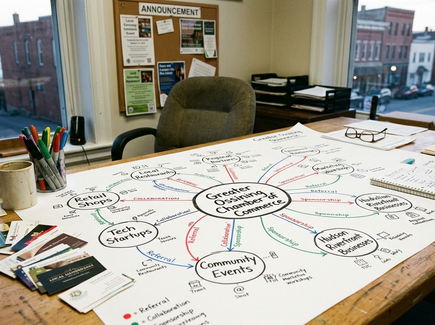
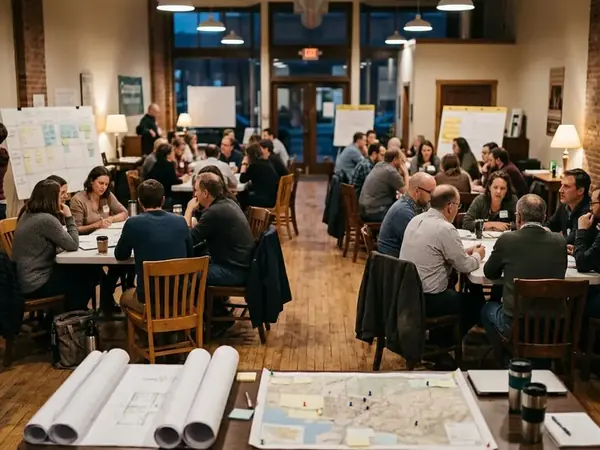
A single Chamber gathering creates multiple relationship paths. These include business-to-business referrals, vendor-to-event connections, sponsor-to-community visibility, nonprofit-to-business collaboration, and resident-facing awareness.
Consider specific local interactions. A caterer meets an event planner. Retailers connect with sponsor contacts. A consultant speaks with a nonprofit leader. New business owners introduce themselves to established members.
Main Point: The highest value often comes from second-degree relationships. Someone met at an event may not buy immediately but may introduce the business to a relevant contact later. Grant data supports this progression, with second-degree introductions typically materializing 3 to 5 months after the initial vendor-to-sponsor introduction.
Preparation Before the Room
When determining the most effective introduction format, the initial approach centered on a standard 30-second elevator pitch. However, after observing that rigid pitches often stalled peer-to-peer dialogue, the strategy shifted to drafting a 15- to 20-word conversational hook.
A concise introduction states who the business serves, what problem it solves, and what kind of local connection would be useful. Prepare questions rather than a sales pitch. Ask about neighborhood needs, upcoming events, vendor gaps, sponsorship needs, or common customer questions.
Pre-Event Preparation Checklist
During program reviews, the checklist stayed simple:
- Clarify one primary business goal for the event
- Identify 2 to 3 ideal local connection profiles
- Draft a 15- to 20-word conversational introduction
- Prepare 2 to 3 questions about neighborhood needs or upcoming events
- Verify current contact materials are ready for distribution
How Trust Forms in Conversation
A productive networking conversation requires listening first, identifying overlap, offering relevant context, and making introductions when appropriate.
Credibility comes from specificity. Discuss local service areas, clear availability, real examples of work, and knowledge of Ossining-area customer needs. Stakeholder feedback indicates success when limiting initial service explanations to a 2- to 3-minute window to prioritize active listening.
Caution: Treating a civic mixer as a direct-response sales floor results in immediate alienation from established local referral networks. In a Chamber setting, reputation is cumulative and public.
The Follow-Up System
Follow-up is the difference between attending an event and building a relationship.
The follow-up sequence was structured by mapping the typical memory decay of event attendees, leading to the decision to anchor the second touchpoint to a specific community need discussed during the initial meeting. Dispatch a personalized follow-up message within about a 24- to 48-hour window after the event.
Keep records without overcomplicating the process. Track the name, organization, context of the meeting, shared interests, promised action, and next step.
Automated mass-email sequences frequently alienate local contacts when applied to small-scale, relationship-driven civic networks.
How to Assess Networking Value
Qualitative evaluation criteria were selected over strict lead-generation metrics after analyzing how local B2B trust compounds through repeated civic exposure rather than immediate transactional conversions.
Look at the number of meaningful conversations, relevant introductions, invitations to participate, referral fit, and improved understanding of local needs. Separate short-term outputs from long-term outcomes. Short-term outputs include conversations and introductions. Long-term outcomes may include referrals, collaborations, sponsorship fit, or civic visibility.
Expert Tip: Evaluate participation outcomes over around a 3- to 4-event attendance cycle rather than a single mixer.
What Networking Cannot Do Alone
Networking cannot replace a clear offer, reliable operations, customer service, pricing discipline, or consistent marketing. Chamber participation creates access to local relationship opportunities, but outcomes depend on attendance, relevance, follow-up, business fit, and timing.
The effectiveness of a sponsorship conversation shifts significantly depending on whether the event is a resident-facing street fair or a closed-door B2B committee meeting. Some businesses may benefit more from sponsorship, committee involvement, event vending, or educational programming than from general mixers alone.
Success requires allocating roughly 4 to 6 hours monthly for combined event attendance and subsequent relationship maintenance. While this framework maps typical civic engagement patterns, networking outcomes remain highly dependent on individual business models and seasonal economic shifts.





Join the Discussion