

Why Local Advocacy Matters Now
Local commerce depends on walkability, visibility, predictable rules, customer access, event activity, and coordination among public and private actors. The Greater Ossining Chamber of Commerce connects local businesses, residents, and community partners through events, advocacy, and shared resources. This function translates recurring business concerns into civic priorities, rather than acting as a partisan lobbying entity.
Ossining’s roughly 3 to 4 distinct commercial corridor types have varying infrastructure needs, so advocacy must remain grounded in physical reality. We are looking at specific environments: downtown Ossining, station-area commerce, waterfront-facing visitor activity, Croton Avenue, Route 9-facing businesses, and neighborhood-serving storefronts. Advocacy campaigns that demand immediate zoning overhauls without accounting for the around 12 to 18-month mandatory environmental and public review cycles often lose credibility with municipal planners. Effective strategy requires matching the scale of the request to the reality of the regulatory environment.
The Business District as a Working System
A commercial district operates as an interdependent system rather than a collection of isolated storefronts. Sidewalks, parking, deliveries, lighting, signage, zoning, transit connections, code enforcement, event calendars, and visitor information all affect commercial activity. When one part fails, such as unclear loading access or slow permit routing, the burden appears directly at the storefront level.
We must distinguish between daily operating friction and long-term competitiveness. Daily friction includes parking confusion, construction disruption, inspection uncertainty, and unclear event logistics—issues that immediately impact the bottom line. Long-term competitiveness involves vacancy patterns, streetscape quality, mixed-use development, and regional visitor perception. Monitoring reports show 45 to 60 minutes for average visitor parking duration before turnover is required in high-density corridors. Standard commercial deliveries require 15 to 20 minute loading windows. While a 15-minute loading zone benefits quick-turnover cafes and dry cleaners, it actively hinders full-service restaurants that require 45 to 60 minute windows for bulk food deliveries.
Priority 1: Streets, Sidewalks, Parking, and Access
Public-facing space serves as the first advocacy priority because it shapes the customer’s initial physical experience before a purchase, reservation, appointment, or event visit occurs. Sidewalk condition, curb management, lighting, wayfinding, pedestrian crossings, snow and storm response, trash placement, bike access, delivery windows, short-term parking, and ADA-conscious access dictate district health.
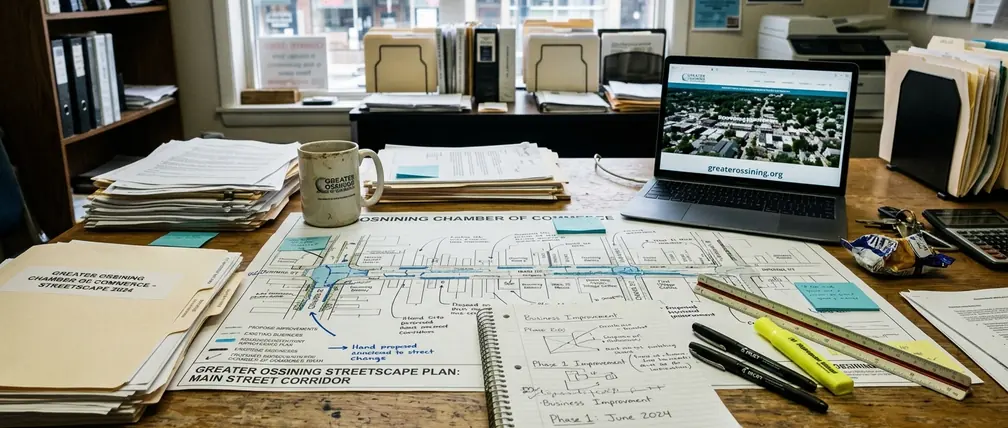
Program evaluation revealed that 36 to 48 inches of clear continuous sidewalk path is required for ADA compliance during outdoor dining setups. Restaurants, service businesses, professional offices, retailers, waterfront visitors, commuters, and event vendors all possess different access needs. Standard municipal response to non-emergency public works requests takes 48 to 72 hours. Advocacy in this space means ensuring that routine maintenance schedules align with peak commercial operating hours.
Priority 2: Predictable Permitting and Plain-Language Rules
Predictability matters as much as speed. Business owners can plan around known requirements, but uncertainty delays leases, buildouts, signage, outdoor setups, hiring, and opening dates. Touchpoints include certificates, signage, outdoor dining, fire and building inspections, event permits, vendor approvals, zoning questions, and health-related requirements.
Initially, the advocacy committee considered pushing for a blanket 14-day approval mandate for all commercial signage. However, after reviewing municipal staffing constraints and the legal requirement for architectural review, this approach proved unworkable. The focus shifted toward establishing clear expectations. Complete permit applications commonly require 21 to 35 days for administrative review. Stakeholder feedback indicates 3 to 5 common failure points in initial commercial permit applications.
Expert Tip: Plain-language tools solve administrative bottlenecks. One-page checklists, process maps, pre-application guidance, role clarity between departments, and published expectations for common business scenarios keep projects moving.
Priority 3: Events That Support Year-Round Commerce
Events function as economic infrastructure when coordinated with merchants, restaurants, service providers, sponsors, performers, nonprofits, and public safety requirements. Successful attendance does not automatically equal business benefit. Planners must consider operating hours, vendor mix, storefront participation, parking, sanitation, accessibility, weather plans, and post-event cleanup.
Coordinating road closures and sanitation schedules for district-wide events usually requires 6 to 8 weeks lead time. Seasonal street festivals often operate within 4 to 6 hour operational windows. The Chamber advocates for an annual civic calendar that reduces conflicts, gives businesses enough lead time, and aligns with village, school, nonprofit, and cultural programming.
Priority 4: Partnerships, Grants, and Public Investment
Many district improvements require partnership because Chambers generally do not control streets, zoning, public budgets, transit assets, or grant awards. Relevant partnership categories include village government, town and county agencies, state economic development programs, schools, cultural organizations, property owners, banks, utilities, nonprofits, and civic volunteers.
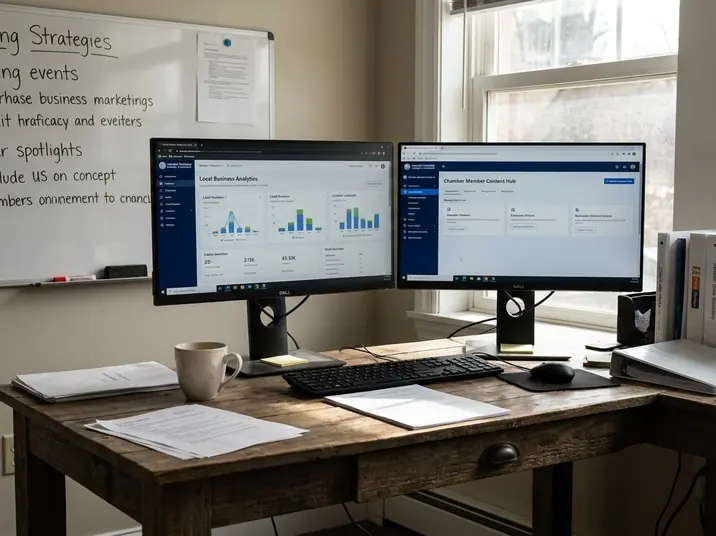
Typical downtown revitalization grants commonly require a minimum 20% local funding match. State economic development funds often attach 3 to 5 year compliance reporting periods. Securing these funds requires coordinated data collection and unified public support.
Caution: State-level downtown revitalization grants cannot be used to subsidize routine municipal operating expenses or private debt service.
How the Chamber Can Turn Concerns Into Action
Moving from analysis to implementation requires a clear operating model: listen, document, prioritize, convene, communicate, advocate, and report back. Compiling and categorizing merchant feedback after a corridor walk-through takes 10 to 15 business days. Formal advocacy progress reports to the membership base occur at quarterly intervals.
Issue intake methods include member surveys with named date ranges, merchant roundtables, corridor walks, sponsor and vendor debriefs, direct business interviews, and review of public agendas. Prioritization criteria weigh the frequency of concern, severity of business disruption, number of affected corridors, feasibility, public benefit, equity across business types, and alignment with municipal processes.
Merchant Issue Intake Checklist
- Document the exact date and time the operational friction occurred.
- Photograph the specific streetscape issue (e.g., blocked loading zone, damaged wayfinding signage).
- Identify the specific municipal department involved, if known.
- Record the estimated financial or operational impact on the business.
Scope and Limits of Chamber Advocacy
The Chamber can convene, document, recommend, support, and communicate. It does not approve laws, issue permits, set tax policy, award public contracts, or control municipal timelines. The typical municipal budget drafting and approval window where advocacy input is viable spans 90 to 120 days. Public hearing agendas generally require 30 to 45 days advance notice.
Competing local interests exist. Residents, property owners, commuters, visitors, employees, public agencies, schools, nonprofits, and business owners may define success differently. For official municipal schedules and hearing dates, consult the Village of Ossining official website.
Measuring Progress
Tracking issue resolution across 3 to 4 distinct municipal departments requires strict documentation. Success is measured not just by policy changes, but by the reduction of daily operational friction for storefronts. Assessing changes in commercial vacancy durations relies on 12-month lookback periods, providing a macro-level view of district health.
Practical Next Steps
Published village board agendas commonly allocate 15 to 20 minutes for public comment periods. To maximize this limited window, an annual advocacy agenda selects 3 to 5 actionable priorities. This focused approach ensures that the most critical systemic issues receive sustained attention.
Main Point: While these advocacy frameworks improve communication between businesses and municipalities, local political shifts and staffing shortages can still delay implementation timelines. Continuous engagement remains the only reliable mechanism for long-term district improvement.










Join the Discussion