

Community events in Ossining work best when vendors understand the assignment before the first tent stake, tablecloth, or payment reader comes out of storage. A vendor space is not merely a rectangle on a site map. It is a temporary public-facing operation inside a shared civic setting.
That distinction matters. The same booth that feels simple in a parking lot can become complicated on a narrow downtown street, near a curb cut, beside a nonprofit information table, or across from a sponsor activation. The checklist below reflects how I think through vendor participation when local commerce, public gathering, visitor comfort, and event logistics all have to occupy the same afternoon.
Where Vendors Fit in Ossining Events
Start with the civic purpose
Ossining community events gather residents, visitors, nonprofits, sponsors, artists, food vendors, and local businesses in one visible public setting. The purpose is broader than sales. These events create a temporary main street where people discover services, meet neighbors, support causes, and spend time in the village rather than passing through it.
Feedback from past events suggests that vendors create fewer day-of-event problems when organizers frame participation as a temporary civic partnership, not just a booth rental. That language may sound formal, but it matches the ground reality. A vendor affects pedestrian flow, noise, waste, safety, visual order, and the visitor experience.
During program reviews, seasonal street fairs have drawn roughly 1,200 to 3,500 attendees over a 4- to 6-hour window. In that kind of setting, small setup decisions become public decisions. A sign placed too far into the walkway, a line forming across a neighboring table, or a generator positioned without clearance can change how the whole block functions.
The Chamber’s role
The Greater Ossining Chamber of Commerce often serves as a local coordination point and information hub, especially when vendors need help understanding the sequence of announcements, applications, setup expectations, and contact channels. That role has limits. The Chamber does not control every permit, approval, property rule, sponsor requirement, or event site.
The practical principle is simple: acceptance into an event does not automatically settle every operational requirement.
Evaluate Fit Before You Apply
Match the event before requesting space
I ask vendors to begin with fit, not availability. A booth can be available and still be a poor match.
Consider a local artisan selling delicate, high-end glass ornaments at a fast-moving children’s festival. The products may be excellent. The maker may be prepared. Still, the event’s energy, audience, weather exposure, and handling risk may not support that booth well. The better question is not “Can I get in?” It is “Will this event let me serve people properly?”
Before applying, answer these questions in writing:
- Is the event indoors or outdoors?
- Does the event provide electricity, or must vendors operate without it?
- Are food sales allowed, restricted, or reviewed separately?
- Are competing categories limited to prevent oversaturation?
- Do sponsors receive priority placement or special visibility?
- Can the booth operate safely within a standard 10x10-foot or 10x20-foot footprint?
- Can staff maintain a 24- to 36-inch clearance for ADA-compliant pedestrian flow?
Capacity is part of fit
A vendor’s staffing plan deserves the same attention as the product list. If one person must sell, restock, answer questions, process payments, manage samples, and watch a line, the booth may not hold up during peak traffic. The issue is not ambition. It is throughput.
Key point: A strong application begins with matching the event’s purpose, audience, site conditions, and vendor capacity, not simply requesting space.
Documents Commonly Requested
Application materials
Most vendor applications ask for a predictable set of materials. Keep them current so each opportunity does not become a scramble.
- Vendor application form.
- Business or organization name.
- Primary contact person and day-of-event contact.
- Booth category, such as retail, food, nonprofit, sponsor, or service provider.
- Clear product or service description.
- Space requirements, including tent size and any equipment needs.
- Payment confirmation when fees apply.
- Signed event rules or participation agreement.
Food vendors often move through a different review path than general retail vendors. That separation helps organizers avoid delaying non-food approvals while food-related paperwork goes through health review.
Insurance in plain language
Many events require a Certificate of Insurance. In common terms, this document shows that the vendor carries liability coverage for the activity taking place at the event. Certificates often require general liability limits of $1,000,000 per occurrence and $2,000,000 aggregate.
The certificate may also need to name the organizer, municipality, property owner, or sponsor as an additional insured when requested. That wording matters because the event site may involve several responsible parties. Insurance requirements can scale with risk; a local artisan selling knitted goods faces a different exposure profile than a vendor operating a propane-powered food cart.
Tax and sales compliance
Vendors making taxable sales in New York may need to register with the New York State Department of Taxation and Finance before selling. The official New York State Department of Taxation and Finance business registration guidance explains the state process.
Do not assume that a general retail permit covers food sampling, even when the food is pre-packaged. One of the cleanest ways to lose a selling day is to arrive with samples that trigger health review but no corresponding approval. Health inspectors do not usually resolve those issues through conversation at the booth.
Build a Practical Application Timeline
Sequence the work
A practical timeline protects both the vendor and the organizer. Application windows generally open 60 to 90 days before the event date, and final vendor selections are usually finalized 21 to 28 days before load-in.
- Review the event announcement and vendor categories.
- Confirm eligibility before preparing payment or inventory.
- Gather documents, including insurance and any permits.
- Submit the application by the stated deadline.
- Wait for acceptance before assuming participation.
- Pay required fees after approval or as directed by the organizer.
- Prepare booth logistics once placement and setup instructions arrive.
Why timing matters
Past event reviews have shown a specific problem with rolling, first-come-first-served acceptance. Organizers could fill a category too early, approving several similar vendors while leaving gaps in food, family activities, services, or nonprofit presence. The process then looked efficient on paper but unbalanced on the street.
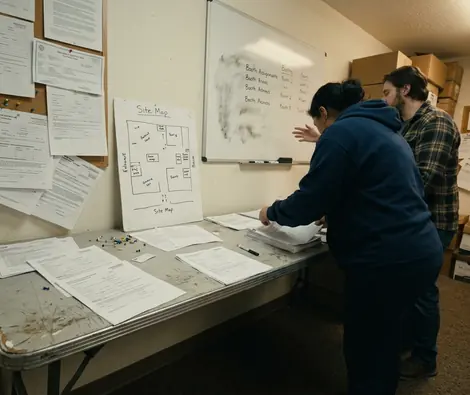
That is why organizers often need time to balance categories, assign booth locations, verify insurance, arrange site maps, and communicate municipal or property requirements. A complete application helps, but it does not remove the need for review.
Practical tip: Keep one digital folder with application confirmations, payment receipts, insurance certificates, permits, contact names, booth assignments, and setup instructions. Name files clearly enough that someone else on your team could find them under pressure.
Prepare the Booth for Event Day
Build the physical checklist
The booth should be ready before the vehicle leaves the driveway. Event mornings do not reward improvisation.
- Commercial-grade tent in the approved footprint, commonly 10x10 feet or 10x20 feet.
- Table and table covering.
- Clear signage visible from the pedestrian path.
- Inventory packed for quick restocking.
- Payment method with backup power or offline capability where appropriate.
- Extension cords only if the event allows them.
- Weather protection for products, staff, and paper materials.
- Trash plan for packaging, samples, and customer waste.
- Lighting if the event extends into evening hours.
Tent weights deserve special attention. Each tent leg should have around 40 pounds attached at minimum, and standard metal stakes are prohibited on paved municipal surfaces. Wind does not need to be dramatic to move an unsecured canopy.
Respect the site as a shared system
Vendors should not block sidewalks, curb cuts, fire lanes, neighboring booths, entrances, or emergency access routes. These rules do more than keep the site tidy. They preserve access for residents using mobility devices, parents with strollers, emergency personnel, and other vendors trying to operate.
Follow assigned arrival times, unloading routes, parking instructions, and booth numbers. The strict load-in approach exists for a reason: narrow downtown streets can turn quickly into vehicle bottlenecks, and delayed setup can hold up public safety inspections.
Caution: Do not redesign your booth footprint on arrival because the assigned space “looks flexible.” The site map reflects pedestrian flow, emergency access, neighboring vendors, and inspection needs.
Rules Vary by Event and Site
Know the authority layers
This guide is an operational overview, not legal, tax, insurance, or permitting advice. On this topic, the gray areas sit where event acceptance meets separate public approvals.
Requirements may differ by event sponsor, Village or Town location, private property rules, public safety needs, weather plans, and vendor category. A civic event acceptance may confirm that the organizer wants you present; it does not necessarily confirm that fire, health, tax, insurance, or property requirements are complete.
Temporary food service permits may need submission to the county health department at least 14 to 21 days before the event. That timeline can affect menus, sampling plans, equipment, and acceptance notices. Vendors should treat food-related questions as early-stage planning items, not last-week details.
Nonprofit and special status assumptions
Municipal fee waivers for nonprofit organizations can have narrow eligibility rules. For example, waivers may apply only to 501(c)(3) entities registered within village limits, excluding regional chapters headquartered elsewhere. A nonprofit mission does not automatically equal a local fee waiver.
The safest habit is to ask the organizer which requirements apply to your exact category, site, and activity. Specific questions produce useful answers.
Follow Up After Participation
Close the site properly
The event does not end for a vendor when the final customer walks away. Pack out fully, remove trash, check for borrowed or rented materials, and leave the space as clean as it was assigned. Site clearance and trash removal may need completion within 60 to 90 minutes after the official event end time to avoid municipal sanitation penalties.
If something broke, spilled, blocked access, or caused confusion, document it while details remain fresh. A short note sent promptly helps the organizer correct the map, load-in plan, signage, or vendor instructions for the next event.
Review performance while memory is fresh
Within about 48 hours, review sales notes, visitor questions, inventory movement, staffing needs, payment issues, and weather-related problems. This is not just accounting. It is preparation for the next application.
A concise thank-you or feedback message also matters, especially for vendors who want to participate in future signature Ossining events. Organizers remember vendors who communicate clearly, respect the site, and help the event serve the public well.
That is the working standard I return to: a good vendor booth sells something, but a strong vendor presence also makes the event easier to navigate, safer to operate, and more welcoming for Ossining.








Join the Discussion