


What Must Performers Agree Before Sharing a Fair Stage?
What must performers and organizers agree on before an act can take a community fair stage?
The agreement begins with space, sound, access, and time. A band needs room for instruments and connections. A dance troupe needs clear decking. A spoken-word performer needs an intelligible microphone signal. Each act occupies the same shared resource differently.
I would make the proposed live format the starting point for every booking decision. Once that format is clear, organizers can assess stage dimensions and load limits, audio capacity, equipment routes, and the changeover window.
Those decisions reach beyond the deck. Amplified bass can compete with another stage; instrument cases can obstruct a vendor entrance; an audience gathering near the steps can block the incoming act. A workable booking accounts for the surrounding fair as well as the performance.
Match Each Live Format to Its Stage
Programming brings audience suitability and production feasibility into the same decision. Artistic quality alone cannot determine whether an act fits a particular location and schedule.
- Amplified band: confirm microphone and instrument inputs, monitors, power, amplifiers, and space for equipment movement.
- Dance troupe: confirm usable floor area, surface characteristics, playback connection, and the person responsible for music cues.
- Spoken-word performer: confirm microphone type, stand placement, and sufficient separation from competing amplified sound.
Consider a dance troupe arriving after a band. Its performance requires the agreed clear floor area, so the booking must account for removing instruments and clearing cables before dancers enter. That transition belongs in the schedule.
Distinguish set duration from total stage occupancy. Moving equipment, checking connections, performing, and clearing the deck all consume time. Where stages operate within earshot, use sequencing, speaker orientation, and suitable amplification to protect quieter performances and nearby conversation.
Move From Application to Written Acceptance
Follow the particular event’s published dates. Applications, selection decisions, technical exchanges, and arrival instructions serve different purposes and should have distinct milestones.
- Submission: provide an act description, representative live recording, proposed set duration, performer count, primary contact, and initial equipment summary.
- Review and selection: organizers assess the proposed format against audience, stage, and scheduling requirements.
- Written booking: both parties accept the assigned slot and participation terms.
- Technical confirmation: reconcile equipment, floor layout, audio connections, and changeover requirements.
- Arrival instructions: confirm check-in, unloading, access, and day-of contacts.
A representative recording should show the format being offered. A solo acoustic application needs material that helps organizers understand that solo performance; a full-band recording suggests different channel, space, and volume requirements.
Written acceptance should settle compensation or community participation terms, weather and cancellation procedures, recording permissions, and responsibility for shared equipment. Treat an application acknowledgment as confirmation of receipt. Reserve the performance commitment for mutual written acceptance of the slot and terms.
Translate the Act Into an Agreed Technical Plan
The technical advance connects the performer’s requirements with the equipment and space organizers will provide. Complete that exchange before arrival so the crew can prepare a coherent stage setup.
This planning example shows how to separate responsibilities:
| Requirement | Performer Contribution | Organizer Provision | Confirmation Status |
|---|---|---|---|
| Vocal microphone | Identify singer and stand position | Agree microphone, stand, and connection | Awaiting agreement |
| Recorded playback | Playback device, local backup, cue operator | Agree compatible audio connection | Awaiting agreement |
| Clear dance area | Describe formation and movement | Confirm usable dimensions and surface | Awaiting agreement |
| Electrical supply | Identify electrical equipment | Technical personnel assign suitable supply | Awaiting agreement |
Keep Inputs Separate From Monitor Requests
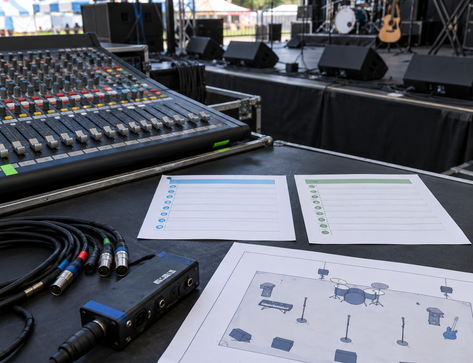
An input list identifies individual signals entering the mixing console: lead vocal, acoustic guitar through a direct box, or separate left and right keyboard feeds. Monitor requests describe what performers need to hear through their floor monitors. Give each its own list.
A stage plot maps performers, microphones, instruments, monitors, amplifiers, and playback equipment from above. Show access paths and movement areas clearly. For dance, identify who starts each track and prepare a local backup that works without cellular service.
Disclose electrical equipment during the advance. The designated technical and electrical personnel handle load calculations, circuit assignments, and temporary-power connections.
Give Soundcheck and Changeover Different Jobs
A soundcheck allows adjustment of the audience mix and performer monitors. A line check verifies that connected microphones, instruments, and playback sources reach the sound system. Confirm which procedure appears on the schedule and prepare accordingly.
Use the holding area to tune instruments, assemble accessories, arrange setlists, and cue the opening playback file. Keep cases and packing work off the active deck.
- The outgoing act removes its designated equipment through the agreed exit route.
- The incoming act moves equipment into the approved positions.
- The technical crew handles patching and checks the connections.
- The stage manager authorizes the start.
Leave shared backline and microphone positions as agreed unless the stage manager and sound technician approve a change. Establish a cut plan beforehand, identifying material that can be omitted if the running order slips. The stage manager controls schedule adjustments and set lengths.
Connect Check-In, Equipment Routes, and Stage Decisions
An arrival plan should carry a performer from the road to the holding area without obstructing public circulation. Confirm these details before event day:
- The designated check-in location.
- The unloading window and load-out instructions.
- The approved route for instruments, carts, and mobility equipment.
- The holding area and stage entrance.
- The direct contact for reporting travel delays.
Keep unloading instructions separate from parking arrangements. After unloading, move vehicles to the designated parking location and keep access routes open.
Route Each Message to Its Decision-Maker
The performer contact coordinates the act’s people, arrival, and readiness. The stage manager controls deck access, starts, schedule changes, and interruption instructions. The sound technician handles audio connections, playback compatibility, and signal problems.
For an audio failure, signal the technician and stage manager and use the agreed backup when directed. During a weather hold or power interruption, stop performing and follow the stage manager’s shelter or evacuation instructions. Leave house equipment, audio patching, and temporary-power disconnections to the designated crew.
Put the Final Agreement on a Performer Run Sheet
Consolidate the settled details into a single-page run sheet that the performer contact and stage manager can use during arrival and changeover.
Include the stage name and location; check-in and changeover times; performance start, finish, and duration; the approved technical-plan reference; organizer-supplied equipment; playback responsibility; and day-of contacts. Add the changeover sequence and the agreed channel for schedule changes or weather-hold messages.
Identify the final version clearly and obtain acknowledgment from both contacts before event day. Make that mutually acknowledged run sheet the operating reference for the performance, so the incoming act and stage crew work from the same agreement.








Join the Discussion