

The Fair’s Footprint Begins With Setup
The Ossining Village Fair’s environmental accounting should begin with vendor setup and end with the final collection vehicle. Preparation and cleanup bring material, energy use, and vehicle movements into the event’s streets before and after visitors arrive. An assessment limited to public opening hours would leave those activities outside the ledger.
Consider a food stall receiving refrigerated supplies and unpacking cardboard before service. Its refrigeration needs and packaging waste already belong to the day’s operations. After service, equipment removal, waste collection, and street cleaning continue the same operational story.
Since no measured fair audit, utility records, or collection weights are currently on file, this guide sets out an assessment method for the annual fair rather than verified environmental results. For the Greater Ossining Chamber of Commerce and participating businesses, the useful starting point is a recordkeeping process that fits a busy street festival.
Temporary food service, merchandise stalls, electrical equipment, visitor travel, and concentrated waste collection each require different evidence. Keeping those records distinct makes the eventual findings easier to check.
Set the Fair’s Time and Street Boundaries
The assessment period should run from the first organizer-controlled setup activity through final cleanup. A boundary sheet should identify the included streets, vendor spaces, loading areas, waste staging points, and support areas using the approved event layout. Specific street routes and total footprints depend on each year's finalized village permit.
Responsibility helps locate evidence. Organizers may hold infrastructure and collection records; vendors may hold appliance and delivery records; visitors can describe their journeys. These categories identify who can supply information without automatically excluding activities outside organizer control.
A compact accounting register gives each activity an owner before event day:
| Activity | Responsible recorder | Evidence | Measurement unit | Known omissions |
|---|---|---|---|---|
| Waste collection | Collection coordinator | Scale logs and collection tickets | Net pounds by stream | Shared loads without fair-only weights |
| Stall electricity | Authorized electrical recorder | Meter readings and connection map | Kilowatt-hours | Unmetered or shared connections |
| Generator operation | Designated operator | Fuel and operating logs | US gallons by fuel | Unrecorded refueling |
| Deliveries and visitor travel | Logistics coordinator | Delivery logs and voluntary responses | Distance, mode, and response counts | Unrecorded journeys and nonrespondents |
Keep material mass, electrical energy, liquid fuel, and travel records in separate ledger fields. A combined carbon figure would require additional conversion sources and assumptions. The physical records remain useful on their own.
Follow Waste Through Collection and Acceptance
Waste accounting starts with separate destinations: residual waste, accepted recyclables, food scraps where collection is available, and reusable supplies retained for another event. Supplies returned to storage deserve an inventory entry rather than a waste weight.
For weighed containers, the calculation is straightforward: net material weight equals gross loaded weight minus empty-container tare. The recorder needs the tare of the actual container, identified so that a different cart or lid does not silently change the subtraction.
Safely obtained scale records or documented collection weights provide stronger evidence than bag counts. Uncrushed beverage containers occupy considerable space; nested food trays occupy much less. Neither bag totals nor container capacity establish measured mass.
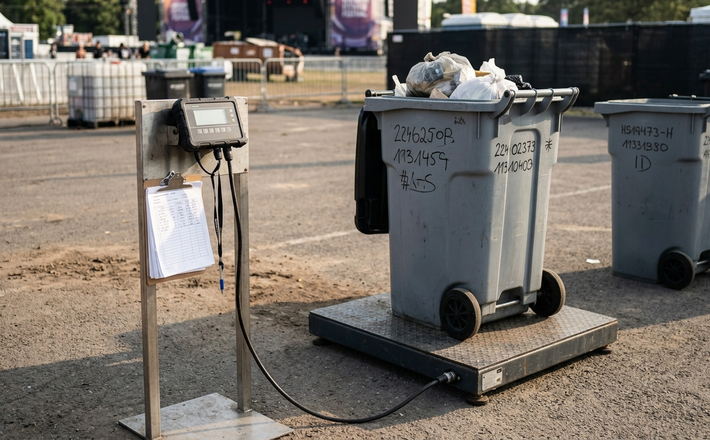
A collection ticket also needs a clear boundary. If a vehicle combines fair material with routine commercial pickups, its total load cannot establish the fair’s waste weight without a documented separation method.
Check the Receiving Service’s Rules
Material placed in a recycling bin has only entered a collection stream. The receiving service’s acceptance rules determine whether that material belongs there. Before printing signs, the coordinator should confirm accepted packaging types, preparation requirements, and any food-scrap service arrangements.
Record contamination or rejected material where that information is available. Label uncertain destinations honestly; a compostable packaging claim alone does not establish access to suitable collection.
Separate Metered Power From Equipment Ratings
Refrigeration, cooking equipment, stall lighting, payment devices, and event sound equipment can all draw electricity. A connection map should show which uses a meter covers and whether several stalls share that supply.
Equipment wattage describes rated demand. Energy consumption also depends on operating time and how equipment cycles. A refrigerator running through setup, service, and cleanup cannot be assessed reliably by treating its rated wattage as constant consumption throughout that period.
Actual meter readings should carry start and finish times. Where direct measurement is unavailable, an estimate should identify its equipment specifications, documented operating time, calculation method, and uncertainty. Keep estimated consumption visibly separate from metered kilowatt-hours.
Keep Power Checks Authorized
Authorized personnel should arrange suitable metering. Vendors should not alter electrical distribution or attach unsuitable plug-in meters to high-load equipment. A shared, un-submetered supply supports a connection-level result, not an isolated stall reading.
Generator records need the fuel type, opening and closing quantities, and any fuel added during operation. The designated operator should use the equipment’s approved measurement procedure and safety requirements. Rated generator capacity alone cannot establish fuel consumption.
Record Fair Journeys Without Assuming Attendance
Visitor travel, vendor deliveries, and organizer logistics can belong within the assessment even when records remain incomplete. A delivery log can document vehicle class, origin area, journey distance, and whether the trip served other destinations. Organizer records can cover equipment delivery and collection movements.
Visitor journeys need a lighter approach. A voluntary questionnaire should request only information needed for the assessment:
- Main travel mode, with connecting modes where relevant.
- Approximate origin area, without a precise home address.
- Vehicle occupancy where a vehicle journey is reported.
- Whether attending the fair was the trip’s primary purpose.
Record when and where responses were collected. That context helps explain which visitors had an opportunity to participate.
Voluntary responses describe respondents. They do not establish the travel behavior of every attendee. Multiple downtown sidewalk entrances also complicate attendance counting, particularly when people leave and return. Without a documented sampling and attendance method, the report should avoid extrapolated travel totals or per-attendee footprints.
A clear account of response coverage is more useful than a precise-looking estimate built on an unknown denominator.
Compare Annual Fairs on Matching Terms
A concise results table should let readers distinguish measured entries, estimates, and missing records immediately. Reporting-period and coverage notes belong beside each result, where they affect interpretation.
| Result | Reporting unit | Evidence and attached coverage note |
|---|---|---|
| Waste by accepted stream | Net pounds | Scale records; included collection areas, period, and rejected material |
| Electricity consumed | Kilowatt-hours | Meter logs; covered connections and estimated entries identified |
| Generator fuel, where applicable | US gallons by fuel | Operator records; operating period and refueling coverage |
| Travel-response coverage | Response counts and recorded journey information | Questionnaire log; collection locations, times, and sampling method |
Annual comparisons require compatible boundaries, collection methods, and measurement units. A broader collection area can increase recorded waste even when individual stalls change little. A newly metered connection can increase reported electricity simply by improving coverage.
Documented changes in operating hours, weather, vendor mix, or collection arrangements should accompany the affected entries. If recycling acceptance rules change, name the change in that stream’s row. Preserve earlier definitions so that the next assessment can distinguish an operational change from a measurement change.
Walk a Hypothetical Food Stall Through the Log
This hypothetical pilot concerns a participating food stall; it does not describe an actual Ossining vendor. Its planned recording window runs from a 07:00 setup arrival to 18:00 curb clearance. The pilot uses a single log, identified containers, an inventory sheet, and an approved electricity record.
- Agree on the stall boundary. Include its preparation area, service space, assigned waste containers, and documented electrical connection. Enter setup start, actual service end, and cleanup completion on the same log.
- Confirm accepted materials and record tare. For this example, the collection service accepts cardboard and specified metal and plastic containers. Label containers for those streams and mixed residual trash. Weigh each empty container on a suitable scale and record its identifier and tare.
- Open the energy and stock records. Have authorized personnel record the approved meter’s starting reading and time. Count opening packaging stock, identifying unopened sleeves and loose items separately.
- Keep service-time entries brief. Whenever a container is removed, the assigned recorder obtains its gross weight safely, subtracts its recorded tare, and logs the net weight under the correct stream. Record replacements by container identifier.
- Close stock and power records. After service, count unopened packaging and loose remainders. Reconcile these against opening stock, noting transfers or damaged supplies rather than treating every missing item as discarded waste. Obtain the closing meter reading for the agreed connection period.
- Complete the stall return. Sum net weights separately for cardboard, accepted containers, and residual trash. Subtract the opening meter reading from the closing reading. Attach collection evidence, mark any shared-power coverage, and enter cleanup completion at curb clearance. File the log, inventory reconciliation, and meter record together under the stall’s identifier.








Join the Discussion